This was distributed to junior high kids in Massachusetts. Just to make the creep factor a little clearer, imagine I wrote something like this for 14-year-old girls and the state agreed to pass it out in school.
Tuesday, September 13, 2011
You need to know


Catholic World News: Vatican, SSPX close to agreement?
Welcome news if true: Catholic World News reports that, in an article available to paid subscribers only, France's Le Figaro claims that an agreement between the Vatican and the Society of St. Pius the 10th is in the offing:
Jean-Marie Guenois, the veteran religion correspondent for the French daily, predicts that a September 14 meeting between the SSPX leader, Bishop Bernard Fellay, and key Vatican officials will lead quickly to a resolution of the split that began in 1998 when the late Archbishop Marcel Lefebvre ordained 4 traditionalist bishops without permission from Rome, resulting in the excommunication of the SSPX leaders.
[. . .]
According to Le Figaro, the proposed agreement would state that the issues raised by the SSPX are not fundamental doctrines of the Church, and it is possible to question them without challenging the authority of Church teaching.
[. . .]
Liberal Catholics will be unhappy with a regularization of the SSPX, Guenois concedes. But liberals will find it difficult to object to the proposed agreement, since they regularly claim to be loyal Catholics while raising questions about certain aspects of Church teaching.
Such a resolution is greatly to be desired- may peace and collegiality reign at last.
 |
| Archbishop Marcel Lefebvre |
Guerrilla ad campaign hits new low after terrified woman thought she was being hunted by a stalker... who turned out to be Toyota
From the what were they thinking department:
And really, where does the actual car come in? We are selling cars, right, Toyota? This has to be, must be, one of the worst advertising campaigns ever conceived, and I'm astonished it was actually executed. I'm not sure who is more culpable, the people who came up with this brainstorm or the car execs who green-lighted it. Both companies might want to audit their "refreshments" budgets: there's a distinct possibility they need reigning in.
They targeted her in a creepy, stalker-themed online advertising stunt - but now the joke is on them.
Toyota and Saatchi & Saatchi are being sued for $10 million after marketeers launched a prank campaign of terror against an unsuspecting woman.
Amanda Duick, from California, first filed papers against the car-maker and ad agency two years ago over the intrusive 'Your Other You' campaign.
Now a court in the U.S has ruled the defendants' claim that she unknowingly agreed to the whole thing was invalid.
Miss Duick's nightmare started when she began receiving frightening e-mails day after day from a strange man.
The man had her home address and appeared to be a 25-year-old beer-guzzling English football hooligan.
He told her he was on the run from the law and needed to hide out at her place with his pit bull Trigger.
But 'Sebastian Bowler' was in fact a fictional character made up by advertising staff.
[. . .]
Unknown to Duick, someone had signed her up for the campaign at YourOtherYou.com, a web site set up for the prank.
The campaign was aimed at 20-something males because Toyota's advertising firm, Saatchi & Saatchi LA, believed men of that age like to prank their friends.
Anyone signing up could choose one of five fictional characters – among them a heavy metal fanatic and a football hooligan.
The character would then barrage the designated friend with text messages, phone calls, e-mails and videos for five days.
The aim was to freak out the friend by making him or her think the stranger possessed personal information about the target - phone number, home address - and was on his way to visit.
And really, where does the actual car come in? We are selling cars, right, Toyota? This has to be, must be, one of the worst advertising campaigns ever conceived, and I'm astonished it was actually executed. I'm not sure who is more culpable, the people who came up with this brainstorm or the car execs who green-lighted it. Both companies might want to audit their "refreshments" budgets: there's a distinct possibility they need reigning in.
 |
| Fake English soccer hooligan created by Saatchi and Saatchi for "guerrilla" Toyota ad campaign. |
Panda mum rescues her falling baby
THIS baby panda must have got a bit bamboozled — losing his grip and nearly falling out of a tree.
But little Tai Shan was lucky — his mum caught him in the nick of time.
See the pictures of the little fella's narrow escape and read the full story at this link.
LifeSiteNews: Official statement from Fr. Frank Pavone in response to bishop’s suspension order
For the past several years, my Ordinary, the Most Reverend Patrick Zurek, Bishop of Amarillo, has given me permission to do the full-time pro-life work that I have done since 1993. In 2005, I made a public promise in a Church ceremony in Amarillo, presided over by a Vatican Cardinal, that this full-time pro-life work would be a lifetime commitment. That's a commitment I promise to fulfill without wavering.
This past week, however, I received a letter from the Bishop insisting that I report to the Diocese this Tuesday, September 13 and, for the time being, remain only there.
I am very perplexed by this demand. Despite that, because I am a priest of the diocese of Amarillo, I will be obedient and report there on the appointed date, putting the other commitments that are on my calendar on hold until I get more clarity as to what the bishop wants and for how long. Meanwhile, I continue to retain all my priestly faculties and continue to be a priest in "good standing" in the Church. The bishop does not dispute this fact. Rather, he has said that he thinks I am giving too much priority to my pro-life work, and that this makes me disobedient to him. He also has claimed that I haven't given him enough financial information.
Now, although Bishop Zurek is my Ordinary, he is not the bishop of Priests for Life. Each of our staff priests has his own Ordinary, and the organization has an entire Board of Bishops. We keep them all informed of our activities, and of our financial audits.
I want to say very clearly that Priests for Life is above reproach in its financial management and the stewardship of the monies it receives from dedicated pro-lifers, raised primarily through direct mail at the grassroots level. To this end, Priests for Life has consistently provided every financial document requested by Bishop Zurek, including annual financial audits, quarterly reports, management documents—even entire check registers! Priests for Life has been completely transparent with Bishop Zurek and any other bishops who have requested information regarding our management and finances. Indeed, we have 21 bishops and cardinals who sit on our Advisory Board, and they are kept fully informed about our finances.
Therefore, in the interest of preserving my good reputation as well as protecting the valuable work done by the Priests for Life organization, I have begun a process of appeal to the Vatican. This process aims to correct any mistaken decisions of the bishop in my regard and to protect my commitment to full-time pro-life activity for my whole life. We are very confident that the Vatican will resolve this matter in a just and equitable fashion. Because of this confidence, we are not currently making any changes in any positions at Priests for Life, or in any of our projects and plans.
I also want to point out that, according to the canon law of the Catholic Church, because I have begun this process of appeal to Rome, the Bishop's order that I return to Amarillo has been effectively suspended. Nevertheless, because of my great respect for this Bishop and my commitment to be fully obedient at all times, I am reporting to Amarillo this Tuesday, in hopes that I can sort this problem out with the Bishop in a mutually agreeable and amicable way.
I would like to note that, unlike other organizations, which have sometimes been critical of the Church hierarchy or other institutions within the Church, Priests for Life has always remained 100% supportive of the Bishops, never criticizing any Church official, and always acting as a megaphone for the Bishops' pro-life statements. Moreover, we serve dioceses and their priests and laity without asking for any speakers' fees, and distribute millions of pieces of pro-life literature to dioceses completely free of charge. We do not seek parish collections, and we work to reinforce in each diocese the local pastoral plan which the bishop wants to implement for pro-life activities.
We are committed to going forward with that same spirit, regardless of the recent action taken by Bishop Zurek.
In the interest of full transparency, I would like to make it known that I do not receive any salary or financial remuneration from either the Diocese of Amarillo or from Priests for Life. Priests for Life, as a Private Association of the Christian Faithful, does provide for my residence and the expenses associated with the ministry, but these expenses are very small. Though, as a diocesan priest, I have never taken a vow of poverty, I have basically chosen to live in that fashion in solidarity with the pre-born children we are trying to protect—who are the poorest of the poor.
I want to be clear that I do not harbor any ill will towards the Bishop of Amarillo, nor do I foster suspicions about his motives. I am merely confused by his actions. It is impossible for me to believe that there is no place in the Church for priests to exercise full-time ministry in the service of the unborn. We do it for the sick, the poor, the hungry, and the imprisoned. But where in the Church is the place where a priest can exercise the same kind of full-time ministry for the children in the womb? That is the question that is at the heart of my own calling.
I am confident that we will be able to resolve this difficulty soon, without any harm to either my own reputation and without any slowdown of the valuable pro-life work we do at Priests for Life.
 |
| Fr. Frank Pavone |
LifeSiteNews: Full statement from Bishop Zurek regarding decision to suspend Fr. Pavone’s public ministry
Your Eminences and Your Excellencies,
I have decided to suspend Father Frank A. Pavone from public ministry outside of the Diocese of Amarillo to take effect on September 13, 2011. For an indefinite period, I am withdrawing my permission to him to minister outside our diocese and am calling him back to spend time in prayer and reflection. My decision is the result of deep concerns regarding his stewardship of the finances of the Priest For Life (PFL) organization. The PFL has become a business that is quite lucrative which provides Father Pavone with financial independence from all legitimate ecclesiastical oversight. There have been persistent question and concerns by clergy and laity regarding the transactions of millions of dollars of donations to the PFL from whom the donors have a rightful expectation that the monies are being used prudently. These financial questions and concerns have persisted with no clear and adequate answers since the time when Father Pavone was under two previous bishop ordinaries. Since he has consistently refused to subject the PFL to a transparent and complete auditing of all expenditures, I have reasons to be alarmed at the potential financial scandal that might arise if it were the result of my failure to correct Father Pavone’s incorrigible defiance to my legitimate authority as his Bishop.
Additionally, the PFL financial resources have afforded Father Pavone with a formidable civil and canonical counsel which he utilized to rebuff my every attempt at calling for financial transparency. Thus, my decision to intervene and to call him to accountability is meant to express the dire need to safeguard his priestly ministry to which I am obligated as his father and to help the Church avoid any scandal due to the national scope of the PFL’s work. At a certain point, for me to hold all this knowledge about the PFL and to turn a blind eye would increase my culpability and quote possibly amount to material cooperation.
In his relationship to his bishop ordinaries, Father Pavone has gradually lost his need to show appropriate obedience to his Bishop. It seems that his fame has caused him to see priestly obedience as an inconvenience to his unique status and an obstacle to the possible international scope of his ministry. I would venture to say that the supreme importance that he has attributed to his PFL ministry and the reductionist attitude toward the diocesan priesthood has inflated his ego with a sense of self-importance and self-determination. This attitude has strained his relationship with me and has give me the impression that I cannot invoke obedience with him because he is famous. It is my desire to help him readjust his priestly bearing through spiritual and theological renewal in order to recapture that essential priestly hallmark of respect and obedience. It is also my desire to strengthen Father Pavone’s sense of communio sacramentalis with me so that he may be fortified with a healthy zeal to live in an authentic way his sacramental gift and mystery as a priest of Jesus Christ.
If you judged it to be prudent, I would like to ask that you would inform the Christian faithful under your care to consider withholding donations to the PFL until the issues and concerns are settled.
Taking this opportunity to express my esteem and to ask for your prayers, I am,
Sincerely yours in Christ,
Most Rev. Patrick J. Zurek, STL, DD
Bishop of Amarillo
 |
| Bishop Patrick J. Zurek, Amarillo, Texas |
A reading from the homilies of St John Chrysostom (Hom 6 on Prayer)
There is nothing more worthwhile than to pray to God and to converse with him, for prayer unites us with God as his companions. As our bodily eyes are illuminated by seeing the light, so in contemplating God our soul is illuminated by him. Of course the prayer I have in mind is no matter of routine, it is deliberate and earnest. It is not tied down to a fixed timetable; rather it is a state which endures by night and day.
Our soul should be directed in God, not merely when we suddenly think of prayer, but even when we are concerned with something else. If we are looking after the poor, if we are busy in some other way, or if we are doing any type of good work, we should season our actions with the desire and the remembrance of God. Through this salt of the love of God we can all become a sweet dish for the Lord. If we are generous in giving time to prayer, we will experience its benefits throughout our life.
Prayer is the light of the soul, giving us true knowledge of God. It is a link mediating between God and man. By prayer the soul is borne up to heaven and in a marvellous way embraces the Lord. This meeting is like that of an infant crying on its mother, and seeking the best of milk. The soul longs for its own needs and what it receives is better than anything to be seen in the world.
Prayer is a precious way of communicating with God, it gladdens the soul and gives repose to its affections. You should not think of prayer as being a matter of words. It is a desire for God, an indescribable devotion, not of human origin, but the gift of God's grace. As Saint Paul says: we do not know how to pray as we ought, but the Spirit himself intercedes for us with sighs too deep for words.
Anyone who receives from the Lord the gift of this type of prayer possesses a richness that is not to be taken from him, a heavenly food filling up the soul. Once he has tasted this food, he is set alight by an eternal desire for the Lord, the fiercest of fires lighting up his soul.
To set about this prayer, paint the house of your soul with modesty and lowliness and make it splendid with the light of justice. Adorn it with the beaten gold of good works and, for walls and stones, embellish it assiduously with faith and generosity. Above all, place prayer on top of this house as its roof so that the complete building may be ready for the Lord. Thus he will be received in a splendid royal house and by grace his image will already be settled in your soul.
Prayer:
Give us the grace, Lord, to continue the works of penitence we have begun so that the Lenten observance we have taken upon ourselves may be accomplished in sincerity of heart.
Prepared by Pontifical University Saint Thomas Aquinas

Abuse victims seek investigation of pope, top Vatican officials
SNAP, the Survivors Network of those Abused by Priests, is attempting to have criminal proceedings instituted against Pope Benedict XVI in the International Criminal Court on the grounds of crimes against humanity, Catholic News Service reports:
Read the rest at this link.

Several victims of clerical sexual abuse, a U.S.-based organization for survivors and a U.S.-based human rights organization formally asked the International Criminal Court to investigate Pope Benedict XVI and other top Vatican officials on charges they bear a responsibility for the abuse of children by Catholic priests around the world.
The Survivors Network of those Abused by Priests and their attorneys from the Center for Constitutional Rights, a New York-based organization, presented their petition to the court Sept. 13, they announced in a press release.
The Vatican press office declined comment.
Read the rest at this link.

Father Pavone suspended from ministry outside Amarillo Diocese
Continuing a rough stretch for celebrity priests in America, Fr. Frank Pavone of Priests for Life has been suspended from active ministry outside the Diocese of Amarillo, Texas by Bishop Patrick J. Zurek of Amarillo.
In a letter to his fellow bishops, Bp. Zurek writes that "My decision is the result of deep concerns regarding his stewardship of the finances of the Priests for Life (PFL) organization... The PFL has become a business that is quite lucrative which provides Father Pavone with financial independence from all legitimate ecclesiastical oversight."
Fr. Pavone announced his intention to comply with his bishop's request stating that "Bishop Zurek asked me to go back to the diocese today, which I am doing for a limited period of time... I am going there and my (priestly) faculties are fully intact and I'm in good standing."
Catholic News Service has the full story.
 |
| Fr. Frank Pavone |
Fides: A few hours after the end of the Week of Peace, another priest has been killed, the sixth in 2011
A 34 year old priest, Fr. Gualberto Oviedo Arrieta, was discovered murdered in the rectory of Our Lady of Carmen, Capurganá, Columbia, on September 12, Fides reports. His body was "covered with wounds and stabs." Nothing appears to have been stolen. The Church in Colombia had just finished celebrating a "Week of Peace" on the night of the 11th. Father Oviedo Arrieta is the sixth priest to be murdered in Columbia this year, "a very worrying figure, which shows the state of violence and moral degradation in our society", Mgr. Juan Vicente Cordoba Villota tells Fides.
 |
| Capurganá, Columbia |

Nato headquarters and US embassy under attack in Kabul
AsiaNews: Hindu nationalist BJP leader LK Advani prays at Marian shrine
Advani, who was educated at a Catholic high school, said "Since I have links with the community, I feel happy coming here, meeting the priests here, participating in the prayers and getting the Blessings."
Shri L.K. Advani, a former leader of the Bharatiya Janata Party (BJ), a Hindu nationalist party, visited the Marian shrine at Mount Mary's Basilica in Bandra, Mumbai, where he placed a garland of red flowers and two candles at the foot of the main altar below the statue of Our Lady. Out of reverence and devotion, he prayed for a few minutes. Along with the Basilica’s Vice Rector, Fr Aniceto Pereira, he recited the Memorae. Fr Pereira gave him as a gift a book on the history of the shrine written by Mgr Francis Correia.
[. . .]
The Marian shrine in Bandra is a place of harmony and interfaith dialogue because the Virgin draws people of all creeds.
 |
| Statue of Mother Mary at Mount Mary Church, Bandra. |
From the Office of Readings for Sept. 13: A sermon by St. John Chrysostom
For me, life means Christ, and death is gain
The waters have risen and severe storms are upon us, but we do not fear drowning, for we stand firmly upon a rock. Let the sea rage, it cannot break the rock. Let the waves rise, they cannot sink the boat of Jesus. What are we to fear? Death? Life to me means Christ, and death is gain. Exile? The earth and its fullness belong to the Lord. The confiscation of goods? We brought nothing into this world, and we shall surely take nothing from it. I have only contempt for the world’s threats, I find its blessings laughable. I have no fear of poverty, no desire for wealth. I am not afraid of death nor do I long to live, except for your good. I concentrate therefore on the present situation, and I urge you, my friends, to have confidence.
Do you not hear the Lord saying: Where two or three are gathered in my name, there am I in their midst? Will he be absent, then, when so many people united in love are gathered together? I have his promise; I am surely not going to rely on my own strength! I have what he has written; that is my staff, my security, my peaceful harbour. Let the world be in upheaval. I hold to his promise and read his message; that is my protecting wall and garrison. What message? Know that I am with you always, until the end of the world!
If Christ is with me, whom shall I fear? Though the waves and the sea and the anger of princes are roused against me, they are less to me than a spider’s web. Indeed, unless you, my brothers, had detained me, I would have left this very day. For I always say “Lord, your will be done”; not what this fellow or that would have me do, but what you want me to do. That is my strong tower, my immovable rock, my staff that never gives way. If God wants something, let it be done! If he wants me to stay here, I am grateful. But wherever he wants me to be, I am no less grateful.
Yet where I am, there you are too, and where you are, I am. For we are a single body, and the body cannot be separated from the head nor the head from the body. Distance separates us, but love unites us, and death itself cannot divide us. For though my body die, my soul will live and be mindful of my people.
You are my fellow citizens, my fathers, my brothers, my sons, my limbs, my body. You are my light, sweeter to me than the visible light. For what can the rays of the sun bestow on me that is comparable to your love? The sun’s light is useful in my earthly life, but your love is fashioning a crown for me in the life to come.
 |
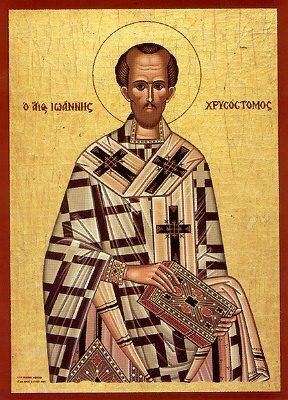
| St John Chrysostom |
Saint of the Day, September 13: Saint John Chrysostom
St. John Chrysostom (347-407): John was named Chrysostom (golden-mouthed) on account of his eloquence. As the Bishop of Constantinople, he made many enemies by reforming the clergy, criticizing the rich for not sharing their wealth, preventing the sale of ecclesiastical offices, calling for fidelity in marriage, and encouraging practices of justice and charity. He is a Doctor of the Church.
 |
| St. John Chrysostom |
Daily Reading, September 13
1 Tm 3:1-13
Beloved, a faithful saying: if a man desire the office of a bishop, he desireth a good work. It behoveth therefore a bishop to be blameless, the husband of one wife, sober, prudent, of good behaviour, chaste, given to hospitality, a teacher, Not given to wine, no striker, but modest, not quarrelsome, not covetous, but One that ruleth well his own house, having his children in subjection with all chastity. But if a man know not how to rule his own house, how shall he take care of the church of God? Not a neophyte: lest being puffed up with pride, he fall into the judgment of the devil. Moreover he must have a good testimony of them who are without: lest he fall into reproach and the snare of the devil.
Deacons in like manner chaste, not double tongued, not given to much wine, not greedy of filthy lucre: Holding the mystery of faith in a pure conscience. And let these also first be proved: and so let them minister, having no crime. The women in like manner chaste, not slanderers, but sober, faithful in all things. Let deacons be the husbands of one wife: who rule well their children, and their own houses. For they that have ministered well, shall purchase to themselves a good degree, and much confidence in the faith which is in Christ Jesus.

Lk 7:11-17
And it came to pass afterwards, that he went into a city that is called Naim; and there went with him his disciples, and a great multitude. And when he came nigh to the gate of the city, behold a dead man was carried out, the only son of his mother; and she was a widow: and a great multitude of the city was with her. Whom when the Lord had seen, being moved with mercy towards her, he said to her: Weep not. And he came near and touched the bier. And they that carried it, stood still. And he said: Young man, I say to thee, arise. And he that was dead, sat up, and began to speak. And he gave him to his mother. And there came a fear on them all: and they glorified God, saying: A great prophet is risen up among us: and, God hath visited his people. And this rumour of him went forth throughout all Judea, and throughout all the country round about.
Beloved, a faithful saying: if a man desire the office of a bishop, he desireth a good work. It behoveth therefore a bishop to be blameless, the husband of one wife, sober, prudent, of good behaviour, chaste, given to hospitality, a teacher, Not given to wine, no striker, but modest, not quarrelsome, not covetous, but One that ruleth well his own house, having his children in subjection with all chastity. But if a man know not how to rule his own house, how shall he take care of the church of God? Not a neophyte: lest being puffed up with pride, he fall into the judgment of the devil. Moreover he must have a good testimony of them who are without: lest he fall into reproach and the snare of the devil.
Deacons in like manner chaste, not double tongued, not given to much wine, not greedy of filthy lucre: Holding the mystery of faith in a pure conscience. And let these also first be proved: and so let them minister, having no crime. The women in like manner chaste, not slanderers, but sober, faithful in all things. Let deacons be the husbands of one wife: who rule well their children, and their own houses. For they that have ministered well, shall purchase to themselves a good degree, and much confidence in the faith which is in Christ Jesus.

Ps 101:1b-2ab, 2cd-3ab, 5, 6
I will walk with blameless heart.
Mercy and judgment I will sing
to thee, O Lord: I will sing,
And I will understand in the unspotted way,
when thou shalt come to me.
I will walk with blameless heart.
I walked in the innocence of my heart,
in the midst of my house.
I did not set before my eyes
any unjust thing.
I will walk with blameless heart.
The man that in private detracted his neighbour,
him did I persecute.
With him that had a proud eye, and an unsatiable heart,
I would not eat.
I will walk with blameless heart.
My eyes were upon the faithful of the earth,
to sit with me:
the man that walked in the perfect way,
he served me.
I will walk with blameless heart.
I will walk with blameless heart.
Mercy and judgment I will sing
to thee, O Lord: I will sing,
And I will understand in the unspotted way,
when thou shalt come to me.
I will walk with blameless heart.
I walked in the innocence of my heart,
in the midst of my house.
I did not set before my eyes
any unjust thing.
I will walk with blameless heart.
The man that in private detracted his neighbour,
him did I persecute.
With him that had a proud eye, and an unsatiable heart,
I would not eat.
I will walk with blameless heart.
My eyes were upon the faithful of the earth,
to sit with me:
the man that walked in the perfect way,
he served me.
I will walk with blameless heart.
Lk 7:11-17
And it came to pass afterwards, that he went into a city that is called Naim; and there went with him his disciples, and a great multitude. And when he came nigh to the gate of the city, behold a dead man was carried out, the only son of his mother; and she was a widow: and a great multitude of the city was with her. Whom when the Lord had seen, being moved with mercy towards her, he said to her: Weep not. And he came near and touched the bier. And they that carried it, stood still. And he said: Young man, I say to thee, arise. And he that was dead, sat up, and began to speak. And he gave him to his mother. And there came a fear on them all: and they glorified God, saying: A great prophet is risen up among us: and, God hath visited his people. And this rumour of him went forth throughout all Judea, and throughout all the country round about.
Monday, September 12, 2011
Fides: NIGERIA - An "emergency forum" has been called on behalf of the Governors of northern Nigeria with regards to the violence in Plateau state
The President of the Forum of Governors of Northern Nigeria, Mu'azu Babangida Aliyu, has organized an emergency meeting for September 21 to tackle the inter-communal violence between Christians and Muslims that has bedeviled Plateau state recently, Fides News Agency reports. Seventy have been killed in the last two weeks, and two bombs exploded in the city of Jos last night, with thankfully no deaths reported in that incident. Things are certainly on the boil and the boil seems to be quickening in a conflict that shames everyone, Christian and Muslim.
 |
| Street scene in Jos, Nigeria |
Fides: Orders to demolish churches in Orissa have been cancelled
Catholics in Orissa, India, win a welcome victory as five churches slated for destruction by the government have had their demolition orders cancelled:
The structures risked being demolished under an order that said that the buildings had sprung up on land owned by the State without permission.
[. . .]
The decision to block the demolitions - inform local sources of Fides - was taken after the meeting between the authorities and a delegation of Christians in Orissa that included two priests (Fr. Mathew Puthyadam and Fr. Jashabandh Pradhan), a lay Catholic (Jyotisen Parichha) and a Monfort missionary (Brother K.J. Markose). Christians also complained about the presence of "anti-social" elements, who continue to intimidate the faithful and undermine social and religious peace in the district.The chief of Kandhamal district gave ample assurance to the delegation concerning the block of the demolition of the chapel in the village of Padunbadi and for the other churches in question, ensuring also measures to stop groups of troublemakers. In the meeting compensation to the faithful who lost homes and property was also discussed, another issue on which the civil authorities have reaffirmed their decision to provide for.
Fides: "The attack on the Israeli embassy is a clear act of breaking with the past", says a missionary from Cairo
A Camboni missionary, Fr.Giovanni, reads the tea leaves surrounding the recent mob attack on the Israeli embassy in Cairo, and sees the shadow of government complicity:
"It is hard to think that it was a spontaneous event. It was a planned event. This attack was carried out by recruited football fans. What is most disturbing is that the embassy was not adequately defended. . . To all of this, an additional key to the reading can be added. The provisional government was formed by members of Mubarak’s military regime. While the latter is on trial, his men rule the Country. But from the trial, some papers that highlight the connivance of the current power holders with past events could emerge. In addition, the mood of the population towards the army has changed. Many are declaring themselves against the army. One could therefore hypothesize underground agreements between the military sectors and Muslim Brotherhood environments, if the military power pave the way for the Muslim Brotherhood, the latter could in return guarantee them a certain impunity. But we are only dealing with hypotheses."
 |
| Photo: AFP; Israeli embassy, Cairo, under attack, September 9. |
America magazine: The Universal Call
America magazine, in its latest editorial, calls for the recognition by the Church of more lay saints:
Ever since the Second Vatican Council spoke of the “universal call to holiness,” there has been a move to recognize more lay men and women as saints, as models of sanctity for lay Catholics.
[. . .]
But when it comes to recognizing saints, the church still tends to favor popes, bishops, priests and members of religious orders.
[. . .]
Fifty years after the council, in the midst of the church’s continued invitations for laypeople to lead holy lives, why are there still relatively few role models for the laity? Surely there are many who fit the definition of holiness: men and women who, aware of God’s love for them, return that love through service to their neighbor, specifically in their humility, charity and self-sacrifice.
Though the logistics may be difficult, the church should find a way to recognize models of holiness in men and women who lived “ordinary” lives. These would include: someone other than a saint from the very earliest days of the church (like St. Joseph), someone who was not royalty (like St. Elizabeth of Hungary), a married person who did not found a religious order in later years (like St. Bridget of Sweden), a couple who did not initially plan to live as “brother and sister” while married (like Louis and Zélie Martin), someone who did not found a religious community or social movement (like Dorothy Day) and someone who did not die in terrible circumstances (like St. Gianna Molla).
While Catholics recognize that the canonized saint needs to have led a life of “heroic sanctity,” many lay Catholics long for someone they can emulate in their daily lives. Which raises a question: Who is holier—Mother Teresa or the church-going mother who for decades takes care of an autistic child? Pope John Paul II or the pious man who serves as a director of religious education while holding down two jobs to support his family? The answer: they are all saintly in their own ways. “Heroic sanctity” comes in many forms—and it includes both those whose faith inspires them to found a religious order and those whose faith enables them to care for a sick child for years on end.
 |
| Servant of God Elisabeth Leseur |
Full text of Pope Benedict XVI's homily at the close of the 25th Italian National Eucharistic Conference
Dearest Brothers and Sisters!
Six years ago, the first apostolic journey in Italy of my pontificate led me to Bari, for the 24th National Eucharistic Congress. Today I came to solemnly conclude the 25th, here in Ancona. I thank the Lord for these intense ecclesial moments, which strengthen our love for the Eucharist and see us united around the Eucharist! Bari and Ancona, two fascinating cities on the Adriatic Sea; two cities rich in history and Christian life; two cities open to the East, to its culture and its spirituality; two cities brought closer by the themes of the Eucharistic Congresses: In Bari we recalled how "we cannot live without Sunday"; today our coming together is under the banner the "Eucharist for daily life."
Before offering you some thoughts, I would like to thank you for your wholehearted participation: In you I spiritually embrace the whole Church in Italy. I address a grateful greeting to the president of the episcopal conference, Cardinal Angelo Bagnasco, for the cordial words he addressed to me also on behalf of all of you; to my Legate to this Congress, Cardinal Giovanni Battista Re; to the Archbishop of Ancona-Osimo, Edoardo Menichelli, to the bishops of the metropolis, of the Marche and to the numerous people gathered from all parts of the country. Along with them, I greet the priests, the deacons the consecrated men and women, and the lay faithful, among whom I see many families and many young people. My gratitude goes also to the civil and military authorities and to all those who, in different capacities, have contributed to the success of this event.
"This is a hard saying; who can listen to it?" (John 6:60). Confronted with Jesus' discourse on the bread of life, in the Synagogue of Capernaum, the reaction of the disciples, many of whom abandoned Jesus, is not very far from our resistance before the total gift that He makes of himself. Because to really accept this gift means to lose oneself, to allow oneself to be drawn in and transformed to the point of living from Him, as the Apostle Paul reminds us in the Second Reading: "If we live, we live to the Lord, and if we die, we die to the Lord; so then, whether we live or whether we die, we are the Lord's" (Romans 14:8).
"This is a hard saying!" It is hard because we often confuse liberty with the absence of chains, with the conviction of being able to make do by ourselves, without God, who is seen as a limit to liberty. This is an illusion that is soon turned into delusion, generating unrest and fear and leading, paradoxically, to longing for the chains of the past: "Would that we had died by the hand of the Lord in the land of Egypt," said the Israelites in the desert (Exodus 16:3), as we heard. In reality, it is only in openness to God, in the acceptance of his gift, that we become truly free, free from the slavery of sin that disfigures man and the capacity to serve the real good of brethren.
"This is a hard saying!" It is hard because man often falls into the illusion of being able to "transform the stones into bread." After having put God aside, or having tolerated him as a private choice that must not interfere with public life, certain ideologies have aimed at organizing society with the force of power and the economy. History shows us, tragically, how the objective of ensuring development, material well-being and peace to all, doing without God and his revelation, has resulted in giving men stones instead of bread. Bread, dear brothers and sisters, is the "fruit of man's work," and enclosed in this truth is all the responsibility entrusted to our hands and to our ingeniousness; but bread is also, and even first "fruit of the earth," which receives from on High sun and rain: It is a gift to be requested, which takes away all arrogance and makes us invoke with the trust of the humble: "Father (...), give us this day our daily bread" (Matthew 6:11).
Man is incapable of giving life to himself, he is understood only from God: it is the relationship with Him that gives consistency to our humanity and renders our life good and just. In the Our Father we pray that His name be hallowed, that His will be done. It is first of all the primacy of God that we must recover in our world and in our lives, because it is this primacy that enables us to rediscover the truth of what we are, and it is in knowing and following the will of God that we find our true good -- to give time and space to God, so that He will be the vital center of our existence.
From whence should we start, as the source, to recover and reaffirm the primacy of God? From the Eucharist: Here God makes Himself so close as to become our food, here He becomes the strength on the way that is so often difficult, here he makes himself a friendly presence that transforms. Already the Law given through Moses was considered as "bread of Heaven," thanks to which Israel became the people of God, but in Jesus the last and definitive Word of God becomes flesh, comes to meet us as Person. He, the Eternal Word, is the true manna, he is the bread of life (cf. John 6:32-35) and to carry out the works of God is to believe in Him (cf. John 6:28-29). In the Last Supper, Jesus summarizes his whole existence in a gesture that is inscribed in the great Paschal Blessing of God, a gesture that He lives as Son as thanksgiving to the Father for his immense love. Jesus breaks the bread and shares it, but with a new profundity, because He gives himself. He takes the chalice and shares it, so that all can drink from it, but with this gesture He gives the "new covenant in his blood," he gives himself. Jesus anticipates the act of supreme love, in obedience to the will of the Father: the sacrifice of the Cross. His life will be taken from him on the Cross, but already now He offers it on his own. Thus Christ's death is not reduced to a violent execution, but is transformed by Him into a free act of love, of self-giving; he goes victoriously through death itself and confirms the goodness of creation which came from the hands of God, humiliated by sin and finally redeemed. This immense gift is accessible to us in the Sacrament of the Eucharist: God gives himself to us, to open our existence to Him, to link it to the mystery of love of the Cross, to render it a participant in the eternal mystery from which we come and to anticipate the new condition of full life in God, in the expectation of which we live.
However, what does this starting from the Eucharist to reaffirm the primacy of God entail for our daily life? Eucharistic communion, dear friends, tears us away from our individualism, it communicates the spirit of Christ dead and risen, it conforms us to Him; it unites us intimately to brethren in that mystery of communion which is the Church, where the one Bread makes of many just one body (cf. 1 Corinthians 10:17), carrying out the prayer of the early Christian community reported in the book of the Didache: "as this broken bread was scattered on the hills, and gathered became only one thing, thus your Church from the confines of the earth is gathered in your Kingdom" (IX, 4). The Eucharist sustains and transforms the whole of daily life. As I reminded in my first encyclical, "Eucharistic communion includes the reality both of being loved and of loving others in turn," for which reason "a Eucharist which does not pass over into the concrete practice of love is intrinsically fragmented" ("Deus Caritas Est," 14).
The 2,000-year history of the Church is studded with men and women saints whose life is an eloquent sign of how in fact from communion with the Lord, from the Eucharist a new and intense assumption of responsibility is born at all levels of community life; born hence is a positive social development, which has the person at the center, especially the poor, the sick and the straitened. To be nourished by Christ is the way not to remain foreign and indifferent to the fortunes of our brothers, but to enter into the very logic of love and of gift of the sacrifice of the Cross; he who is able to kneel before the Eucharist, who receives the Lord's body cannot fail to be attentive, in the ordinary course of the days, to situations unworthy of man, and is able to bend down personally to attend to need, is able to break his bread with the hungry, share water with the thirsty, clothe the naked, visit the sick and imprisoned (cf. Matthew 25:34-36). He will be able to see in every person the Lord who did not hesitate to give the whole of himself for us and for our salvation. Hence, a Eucharistic spirituality is a real antidote to individualism and egoism that often characterize daily life, and leads to the rediscovery of gratuitousness, the centrality of relationships, beginning with the family, with a particular care for binding the wounds of the broken. A Eucharistic spirituality is the soul of an ecclesial community that overcomes divisions and oppositions and appreciates the diversity of charisms and ministries putting them at the service of the unity of the Church, of her vitality and of her mission. A Eucharistic spirituality is a way to restore dignity to man's days and, hence, to his work, in the quest for reconciliation with the times of celebration and the family and in the commitment to surmount the uncertainty of precariousness and the problem of unemployment. A Eucharistic spirituality will also help us to approach the different forms of human fragility conscious that they do not obfuscate the value of the person, but require closeness, acceptance and help. Drawn from the Bread of life will be the vigor of a renewed educational capacity, attentive to witnessing the fundamental values of life, of learning, of the spiritual and cultural patrimony; its vitality will make us inhabit the city of men with the willingness to spend ourselves on the horizon of the common good for the building of a more equitable and fraternal society.
Dear friends, let us leave the Marche land with the strength of the Eucharist in a constant osmosis between the mystery that we celebrate and our daily situations. There is nothing that is genuinely human that does not find in the Eucharist the right way to live it in fullness: hence, daily life becomes the place of spiritual worship, to live the primacy of God in all circumstances, within a relationship with Christ and as an offering to the Father (cf. Postsynodal Exhortation "Sacramentum Caritatis," 17). Yes, "man shall not live by bread alone, but by every word that proceeds from the mouth of God" (Matthew 4:4): We live from obedience to this word, which is living bread, to the point of entrusting ourselves, like Peter, with the intelligence of love: "Lord, to whom shall we go? You have the words of eternal life; and we have believed, and have come to know, that you are the Holy One of God" (John 6:68-69).
Like the Virgin Mary, let us also become a "womb" willing to offer Jesus to the people of our time, reawakening the profound desire for that salvation that comes only from Him. Good journey, with Christ the Bread of life, to all the Church that is in Italy!
Translation by ZENIT
Vatican Radio: BXVI: Peace, a mandate as a well as a gift
Linda Bordoni of Vatican Radio reports on a message of Pope Benedict XVI to the Community of Sant’Egidio which is holding a conference entitled “Bound to live together”:
Hear Linda Bordoni's full report at this link.
To the men and women of the world's great religions convened by the Community of Sant'Egidio and the Archdiocese of Munich and Freising for the 3-day meeting, “Bound to live together”, the Pope said that peace is a permanent mandate entrusted to us as well as a gift to be invoked.
[. . .]
The title of the meeting – Pope Benedict said – reminds us that we humans are destined to live together, not next to each other, but with each other. It is therefore our duty – he continued – to be open to each other, and whilst once this could have been a regional reality, cohabitation today is between the whole of humanity. Let us remember – Benedict said – that Christ has announced peace to the far and near, and that God desires that we form one family, in which we are all brothers and sisters.
Hear Linda Bordoni's full report at this link.
Vatican Radio: Pope Benedict XVI's September 11th appeal to world’s leaders to reject violence
Vatican Radio reports:
From the Adriatic port city of Ancona this Sunday, Pope Benedict XVI raised an appeal to world leaders to always reject violence as a solution to problems. The Pope had flown into the eastern Italian city to preside at the conclusion of the 25th Italian National Eucharistic Congress, but during the midday Angelus – for a second straight day – his thoughts went to September 11th of ten years ago and to the victims of the terrorist attacks on New York’s Twin Towers, on Washington and on Pennsylvania:
“Today, our thoughts also go to September 11 ten years ago. In entrusting the victims of the terrorist attacks on that day and their families to the Lord of Life, I invite the leaders of nations and men of good will to always refuse violence as the solution to problems, to resist the temptation toward hatred and to work in society, inspired by the principles of solidarity, justice and peace”.
On Saturday in a letter to the President of the US bishops’ conference, Archbishop Timothy Dolan of New York, the Holy Father had written about the brutality of the 9/11 attacks that killed almost 3, 000 people. He wrote that nothing can justify terrorism and that what happened is further compounded by the perpetrators’ claim to be acting in the name of God.
His latest appeal resounded across the deep blue of the Adriatic sea, a perfect backdrop to the Sunday liturgy which saw Italy’s biggest shipyard transformed into an open air cathedral. An estimated 100 thousand people drawn from the nations 42 Metropolitan Archdiocese had gathered for the week long congress in Ancona on the theme “The Eucharist for every day life” inspired by the passage from the Gospel of John on Christ’s sermon on the Bread of Life.
In gifting Himself daily in the Eucharist – Pope Benedict said in his homily – God offers us " the path to avoid indifference to the fate of our brothers and sisters, to enter the same logic of love and gift of sacrifice of the Cross". He said : "Those who know how to kneel before the Eucharist, those who receive the body of Christ can not fail to be attentive, in the unfolding of the day, to situations unworthy of man and know firsthand how to bend over the needy, how to break bread with the hungry, how to share water with the thirsty, clothe the naked, visit the sick and imprisoned".
Commenting on the phrase that begins today's Gospel "This is a hard saying," Pope Benedict said that "it is hard because often we confuse freedom with the absence of constraints, in the belief that we can make it alone, without God, seen as a limit to freedom. This is an illusion which soon turns into disappointment, generating fear and anxiety and leading us, paradoxically, to regret the chains of the past: "If only we had died at the Lord’s hand in the land of Egypt ..." - said the Jews in the desert (Ex 16.3), as we heard. In fact, only in openness to God, in welcoming His gift, do we become truly free, free from the bondage of sin which disfigures the face of man and able to serve the true good of our brothers".
The Pope continued : "It is hard because man often falls into the illusion of being able to "turn stones into bread." After having put God aside, or having tolerated Him as a private choice that should not interfere with public life, certain ideologies have tried to organize society by the force of power and the economy. History dramatically shows us how the goal of ensuring development, material well-being and peace to all, excluding God and his revelation, resulted in people being given stone instead of bread. Bread, dear brothers and sisters, is the "fruit of human hands", and in this truth lies all the responsibilities entrusted to our hands and our ingenuity; but bread is also, and before that, "fruit of the earth ", which receives the sun and rain from above: it is a gift to be asked for, that takes away all of our pride and makes us cry out with the confidence of the humble:" Father (...), give us this day our daily bread "(Matt. 6:11)".
"Man is incapable of giving life by himself, he can only be understood starting from God: it is our relationship with Him, that gives consistency to our humanity and makes our lives good and right. In the Our Father we ask that His name be hallowed, that His kingdom come, that His will is done. Above all else, we must recover the primacy of God in our world and our lives, because it is this very primacy that allows us to recover the truth of who we are, and it is in knowing and following the will of God that we find our true good. Give time and space to God, so that he is the vital centre of our existence. Where to start, as if from the source, to recover and reassert the primacy of God? From the Eucharist: there God draws so close that He becomes food for us, here He becomes strength in the often difficult journey, here He becomes a friendly presence that transforms".
Pope Benedict concluded : "A Eucharistic spirituality, then, is the real antidote to the individualism and selfishness that often characterize daily life, it leads to the rediscovery of gratuity, of the centrality of relationships, starting from the family, with particular attention to healing the wounds of those that are broken. A Eucharistic spirituality is the soul of a church community that goes beyond divisions and conflicts and promotes the diversity of charisms and ministries by placing them in the service of the unity of the Church, its vitality and its mission. Eucharistic spirituality is a way to restore dignity to man’s everyday life and therefore to his work, in the search to reconcile it with times of celebration and family life and with a commitment to overcome the insecurity and uncertainty of the unemployment problem. A Eucharistic spirituality will also help us to draw close to the different forms of human frailty aware that they do not overshadow the value of the person, but require closeness, welcome and help. A renewed educational vitality can draw force from the Bread of life, attentive to witness the fundamental values of existence, of knowledge, of our spiritual and cultural heritage, its vitality will help us live in the city of mankind with the willingness to spend ourselves for the horizon of the common good to build a more just and fraternal world".
(Vatican Radio draft translation)
From the Office of Readings for Sept. 12: St Augustine's sermon On Pastors
The shepherds who feed themselves
Let us consider the unflattering words of God which Scripture addresses to shepherds who feed themselves and not the sheep. You consume their milk and cover yourselves with their wool; you kill the fatlings, but my sheep you do not pasture. You have failed to strengthen what was weak, to heal what was sick, and to bind up what was injured. You did not call back what went astray, nor seek out what was lost. What was strong you have destroyed, and my sheep have been scattered because there is no shepherd.
This is spoken to the shepherds who feed themselves and not the sheep; it speaks of their concern and their neglect. What is their concern? You consume their milk and cover yourselves with their wool. And so the Apostle asks: Who plants a vineyard and does not eat from its fruit? Who pastures a flock and does not drink from the milk of the flock? Thus we learn that the milk of the flock is whatever temporal support and sustenance God’s people give to those who are placed over them. It is of this that the Apostle was speaking in the passage just quoted.
Although he chose to support himself by the labour of his own hands and not to ask for milk from the sheep, the Apostle did say that he had the right to receive the milk, for the Lord had established that they who preach the Gospel should live from the Gospel. Paul also says that others of his fellow apostles made use of this right, a right granted them, and not unlawfully usurped. But Paul went further by not taking what was rightfully his. He forgave the debt, whereas the others did not demand what was not due them. Therefore Paul went further. Perhaps his action was foreshadowed by the Good Samaritan who, when he brought the sick man to the inn, said: If you spend any more, I will repay you on my way back.
What more can I say concerning those shepherds who do not need the milk of the flock? They are more merciful; or rather, they carry out a more abundant ministry of mercy. They are able to do so, and they do it. Let them receive praise, but do not condemn the others. The Apostle himself did not seek what was given. However, he wanted the sheep to be fruitful, not sterile and unable to give milk.
 |
| Saint Augustine, from a painting by Philippe de Champaigne |
Saint of the Day, September 12: Blessed Apollinaris Franco
Blessed Apollinaris Franco (d. 1622); martyr: Born in Spain, Blessed Apollinaris studied law at the University of Salamanca. After joining the Franciscans, Blessed Apollinaris was sent to Japan as a missionary in 1614, despite the fact that the practice of Christianity was punishable by death in Japan at that time. Arrested in 1617, he spent five years in jail in Nagasaki with other Christians under harsh conditions designed to coerce the prisoners into rejecting their faith. The joy of God could not be crushed, and he spent his time in prayer and preaching, even converting his jailers. On September 12, 1622, during what is known as the Great Martyrdom of Nagasaki, he and the other Franciscans with him were burned at the stake.


Daily Reading, September 12
1 Tm 2:1-8
Beloved:
I desire therefore, first of all, that supplications, prayers, intercessions, and thanksgivings be made for all men: For kings, and for all that are in high station: that we may lead a quiet and a peaceable life in all piety and chastity. For this is good and acceptable in the sight of God our Saviour, Who will have all men to be saved, and to come to the knowledge of the truth. For there is one God, and one mediator of God and men, the man Christ Jesus: Who gave himself a redemption for all, a testimony in due times. Whereunto I am appointed a preacher and an apostle, (I say the truth, I lie not,) a doctor of the Gentiles in faith and truth.
I will therefore that men pray in every place, lifting up pure hands, without anger and contention.

Ps 28:2, 7, 8-9
Blessed be the Lord, for he has heard my prayer.
Hear, O Lord, the voice of my supplication, when I pray to thee;
when I lift up my hands to thy holy temple
Blessed be the Lord, for he has heard my prayer.
The Lord is my helper and my protector:
in him hath my heart confided, and I have been helped.
And my flesh hath flourished again, and with my will I will give praise to him.
Blessed be the Lord, for he has heard my prayer.
The Lord is the strength of his people,
and the protector of the salvation of his anointed.
Save, O Lord, thy people, and bless thy inheritance:
and rule them and exalt them for ever.
Blessed be the Lord, for he has heard my prayer.
Lk 7:1-10
And when he had finished all his words in the hearing of the people, he entered into Capharnaum. And the servant of a certain centurion, who was dear to him, being sick, was ready to die. And when he had heard of Jesus, he sent unto him the ancients of the Jews, desiring him to come and heal his servant. And when they came to Jesus, they besought him earnestly, saying to him: He is worthy that thou shouldest do this for him. For he loveth our nation; and he hath built us a synagogue. And Jesus went with them. And when he was now not far from the house, the centurion sent his friends to him, saying: Lord, trouble not thyself; for I am not worthy that thou shouldest enter under my roof. For which cause neither did I think myself worthy to come to thee; but say the word, and my servant shall be healed. For I also am a man subject to authority, having under me soldiers: and I say to one, Go, and he goeth; and to another, Come, and he cometh; and to my servant, Do this, and he doth it. Which Jesus hearing, marvelled: and turning about to the multitude that followed him, he said: Amen I say to you, I have not found so great faith, not even in Israel. And they who were sent, being returned to the house, found the servant whole who had been sick.
Saturday, September 10, 2011
David Cameron, churlish jackass
This reveals something unpleasant about the man, a thoughtless, supercilious, cavalier and casual attitude towards cruelty.
His first and only reaction to the unintended affect of his words was to snigger himself at the woman he'd made a joke of. No thought for Ms. Dorries who he left humiliated, not a one. I doubt he'd have much concern for you or I, either, and I'd rather not ever have him around.
This isn't the kind of thing you can take back, David. We know who you are now.
This isn't the kind of thing you can take back, David. We know who you are now.

The Sun: Picture that predicted 9/11
Chilling Twin Towers image was hanging in office from 1988
THE nightmare of the Twin Towers is captured in a haunting picture — made by a Brit 13 years BEFORE 9/11.
The chalk drawing of passenger jets, skyscrapers, flames and a scared child emerged yesterday ahead of tomorrow's solemn tenth anniversary of the terror attacks.
[. . .]
Astonished New Yorker Michael Devers declared after seeing the image: "How did this man in Scotland predict the future so accurately? It's beyond spooky."
The picture itself is at the link. Decide for yourself; I really don't see it.
Postal workers refuse to deliver Bible recordings because the CDs are ‘offensive’
Sad but true. Several churches on the Channel Island of Jersey banded together to have discs of St. Mark's Gospel sent to every household on the island. Campaigns launched so that those who were interested could listen along together, were scotched Jersey Post refused to deliver the 45,000 recordings on the grounds that they are offensive. It will take a month to deliver each recording by hand, ruining the communal aspect of the project.
There has been a belated apology:
There has been a belated apology:
Jersey Post apologised for the incident, saying staff had misinterpreted guidelines.Clearly? The fact is that there are a great many people now like "the person involved'. And they have a lot of sway, as in this case. Only when there is publicity are such incidents reversed, and not always even then.
Chief Executive Kevin Keen, said: 'I understand that one of my colleagues did say the material was offensive.
'This decision was made on the basis of our terms and conditions which states that we have the right to refuse to distribute something that falls under the category of 'promotional material which could cause offence'.
'Clearly this was interpreted in the wrong way. I have spoken to the person involved and have written to all of my colleagues asking that they come to me if there is any doubt in their mind in the future.'
 |
| Samizdat |
Catholic News Service: In his homeland, pope to face growing secularism, some protests
Cindy Wooden of CNS reports on the climate Pope Benedict will find during his upcoming Apostolic Voyage to Germany. Germany is much changed since he left for Rome: East and West have reunited, and the culture has become more secular. There will, indeed, be protests:
The pope, of course, is very aware of recent trends in European culture:
Several groups have announced they will protest the pope's visit, including a group that believes the pope's speech Sept. 22 to the Bundestag, the German parliament, violates church-state separation. Some deputies have announced they will leave the hall in Berlin's Reichstag Building to protest.
Archbishop Rainier Woelki of Berlin told reporters Sept. 7 that the church is not worried about possible protests, considering that Germany is a democracy. But, he said, it would be better if people heard what the pope had to say before reacting.
The pope, of course, is very aware of recent trends in European culture:
Pope Benedict's pastoral visits are designed to strengthen and confirm Catholics in their faith and the statistics clearly illustrate why the theme chosen for the pope's visit to Berlin, Erfurt, Freiburg and Eichsfeld is: "Where there is God, there is a future."
As with Pope Benedict's visits to other European countries -- particularly to France in 2008 and to Scotland and England in 2010 -- secularism is expected to be a key theme during the pope's trip.
"The Holy Father knows the situation of the church in Germany," Jesuit Father Hans Langendorfer, secretary of the German bishops' conference, told reporters Sept. 7.
Zenit: Teresa of Avila Called an Antidote to New Age Deceits
St. Teresa of Avila's understanding of the link between the trinity and all other human mysteries is enough to discredit the pseudo-mysticism of the New Age, according to a Spanish prelate.
Bishop Cecilio Raúl Berzosa Martínez of Ciudad Rodrigo said this Sept. 4 at the conclusion of the weeklong 2nd International Teresian Congress.
[. . .]
He explained that St. Teresa's "The Way of Perfection" provides "keys or antidotes to confront the mystical deceits of the New Age." For example, he drew from her teachings to refute pantheism, and the pretension of being able to save oneself.
The prelate detailed spiritual features and theological elements of New Age and highlighted some of the points in which it contrasts with Christianity. He contrasted it with the mysticism of Teresa of Avila and John of the Cross.
Bishop Berzosa warned that New Age "does not go against religions but tries to transcend them from within."
In this connection, he summarized the process: "the 60s, Christ yes, the Church no. The 70s: God yes, Christ no. The 80s: Religion yes, God no. The 90s: spirituality yes, religion no."
[. . .]
The prelate said those most drawn to New Age spirituality are "people of the first world, of the middle class, between 25 and 50 years of age -- whose stomachs are full, but whose heads and hearts are empty, and who are the great absent ones from our Christian communities."
Still, Bishop Berzosa proposed that "New Age fashion will vanish but the questions posed by it will remain (...) questions that Christianity has been able to respond to, and will respond to from the profound and integral mystery of Jesus Christ."
 |
| St. Teresa of Avila, detail of a painting by François Gerard (1827) |
LifeSiteNews: Study: father’s presence makes children happier, more intelligent
 |
| Erin Pougnet, Ph.D. candidate at Concordia University who carried out the study that was recently published in the Canadian Journal of Behavioural Science |
LifeSiteNews: Wikileaks cable: U.S. gov’t largest supporter of Philippines population control in past 40 years
A diplomatic cable recently published by the controversial website Wikileaks confirms the depth of support by the U.S. government for population control initiatives in the Philippines over the past 40 years, including support for the highly contested Reproductive Health (RH) Bill currently under consideration in the Philippine legislature.
“Landmark appropriations and draft legislation reflect increasing commitment within the Philippine Government to further expand and sustain programs started forty years ago with U.S. Government’s assistance through USAID,” former U.S. Ambassador to the Philippines Kristie Kenny said in the cable. “The U.S. Government continues to be the largest donor in the Philippine population sector supporting efforts to improve local government service delivery and increase private sector contributions to family health outcomes.”
The cable, sent from Manila to Washington, D.C. in July of 2008, was released by Wikileaks at a time of intense debate within the Philippine legislature, and among the Filipino people, about the state funding of contraceptives, abortifacients and other “family planning” services through the RH Bill.
Subscribe to:
Posts (Atom)