There is more than a shadow on the case of Asia Bibi, a 40-year old Christian woman, who was sentenced to death for blasphemy. Asia was judged by a court "under the obvious pressure of Islamic extremists", and "for personal vendetta". In addition there is an obvious procedural irregularity: during the investigations and preliminary interrogations, conducted by the police after the complaint, Asia did not have a lawyer: for this reason the whole trial could be invalidated. This is what is stated in a note sent to Fides by the influential Muslim study Centre "Jinnah Institute" in Karachi.
[. . .]
The note by the "Jinnah Institute" on Asia Bibi brings attention to the case of the woman who for over a year languishes in the prisons in Sheikhupura in Punjab. Even Pope Benedict XVI launched an appeal for her release in November 2010. . . The Jinnah Institute reports that from the outset, Asia Bibi’s court case was marred by irregularities and manipulations. The "National Commission on the Status of Women", after a meeting with Asia Bibi in jail, found that "only 8 days after the alleged incident - in which Asia pronounced blasphemous sentences - Qari Muhammad Salim, a local Muslim religious leader, using three women as witnesses, was able to register an official First Information Report FIR on the basis of which Asia was arrested". During the 8 days allegations against Asia had been orchestrated. These suspicious circumstances - note the Jinnah Institute - are described in the Report written by Shabhaz Bhatti and Salman Taseer and delivered to the President of Pakistan, Ali Zardari. The Report highlights that "the judge sentenced her due to pressures by Islamic extremists, ignoring the true facts".
He said the Episcopal ordination gives bishops the fullness of the Sacrament of Holy Orders in order to “serve the universal priesthood of all the faithful.”
He said bishops have a responsibility to be vigilant and work to ensure that the baptized grow in the grace and charisms that the Holy Spirit stirs up in their hearts and in their communities. He pointed out that baptism makes a person a “son in the Son”, and this divine filiation allows the Christian to participate in the Trinitarian communion.
The Pope told the bishops to welcome the gifts of the laity for the sanctification of the Church and the vitality of the apostolate, while reminding them of their duty to discern the authenticity of these charisms.
“We must be clear that no charism can exist without reference and submission to the Pastors of the Church,” he said.
Pope Benedict then went on to say the complex and delicate ministry of the bishop requires him to have a strong spiritual life. He said the personal holiness of the bishop should manifest the objective holiness of the Episcopal Office. He encouraged them to a life of prayer, nourished by meditation on the Word of God, personal study, and proper rest.
Speaking at a press conference before he celebrated Mass at Amarillo’s cathedral, Father Pavone said that “I do not foresee myself staying incardinated in Amarillo.”
“It’s a sensitive issue,” he added. “We’re working it out behind the scenes. But I say that in light of the bishop’s apparent unwillingness to let me do pro-life work full time, I will seek that elsewhere.”
Note: Okay, all well and good I suppose, but why not just take the open and confident step of having an independent audit conducted and be done with this? Because it seems that is what is required, and it seems that is wholly reasonable, and it seems stubborn not to allow this to be done as though it were some monstrous indignity.
People are anxious after the Corapi affair, Fr. Pavone. We- I- don't like to see a defense that appears tactical and evasive. We do not want to see a defense that cleverly and by insinuation puts one's bishop on trial. Ease our minds and resolve this matter transparently.
You have said you have given your bishop adequate financial information, including audits:
Why in the world should this be a sticking point? It does, I hate to say, raise suspicions. This would be a simple thing to rectify, so why not just do so, rather than give the appearance of phoning friends in Rome to circumvent the process, or seeking a new and more convenient bishop when the one you have becomes a bother?
Again, after Corapi, no one wants procedural tactics and spin. If you can't salvage the relationship with your bishop and must move on, fine (although canonist Ed Peters notes that this is not so easily done, and it is surely not done subject to the petitioning priest's will), but have the independent audit first. Respect this process, because everyone's confidence in high profile priests is frayed by recent events. The moment you announce the intention to do so we will all be reasonably assured that this is a tempest in a teapot and that there really is "no there there".
If instead you act too big for your britches, attempt to short-circuit the process, appear to be trying to "muscle" your bishop, subtly encouraging pickets and protests against him, then you will be strengthening the case that it is unwise to have celebrity priests unanchored to a specific parish assignment who take on national or international responsibilities. It would seem then that such people too easily become ungovernable and laws- potentially even churches- unto themselves, and that such arrangements need to be dissolved and never allowed again. There is nothing to gain by a stroppy and obstructing defense. If applied such a defense would call into question the very wisdom of the freedom that you have been heretofore blessed with, the results of which have been such a blessing to us and to the unborn. This is a crucial time. Please choose your course with care.
If one has nothing to conceal than scrutiny is not to be feared. The very act of allowing the thorough inspection that your bishop requires would certainly put all minds at ease, because it would signal more loudly than any blog post or press release that you have absolutely nothing to hide. Don't negotiate, don't discuss: submit and be done with it. Please.
Enough of that, now back to the article:
Msgr. Harold Waldow, the diocese’s vicar of clergy and moderator of the curia, said that Bishop Zurek has extended his financial inquiry beyond Priests for Life to two other organizations associated with Father Pavone: Rachel’s Vineyard, which offers healing to women who have abortions, and the Missionaries of the Gospel of Life, a lay association.
“I’m sure that our bishop does not stand alone on this,” said Msgr. Waldow. “He is in a community of other bishops who have had the conversation also with the Holy See in Rome, asking questions as to ... what is being done with the monies. I think Rome has been quite clear the bishops of the United States need to exercise more prudential guidance and governance over the patrimony of the Church.”
Most Christians, therefore, understand in essence the Sept. 14 feast of the "triumph" of the Cross of Jesus. For through his suffering, death, and resurrection, Satan is defeated, death loses its sting, and the gates of paradise are flung open to all who will receive the pass of the Passion. That is something to celebrate.
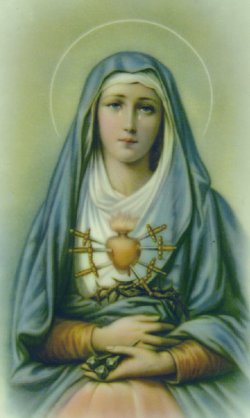
But why the Sorrowful Mother?
We could just as well ask St. Paul why he instructs all Christians to "make up what is lacking in the sufferings of Christ for the sake of his body, which is the Church" (Colossians 1:24).
We Christians, too, will suffer and do suffer. Our suffering has the capacity to release a portion of the infinite graces merited by Jesus at Calvary, what theologians call "objective redemption." But as these redemptive graces of Jesus must be personally received by the human heart, every Christian has a role in this mysterious release and reception of grace which theologians call "subjective redemption."
Mary alone, as the "New Eve" with Jesus the "New Adam", participates in both objective and subjective redemption: both in the historic acquisition of redemptive grace and in the providential release of redemptive grace. Blessed John Paul would teach of his mother and ours that Mary's intensity of suffering at Calvary was a "contribution to the redemption of all" ("Salvifici Doloris," 25).
This is why the Church, including popes, saints, mystics, and faithful alike, have traditionally referred to Mary as the Co-redemptrix. In the simplest of explanations, this title means that Mary helped Jesus save souls like no other.
[. . .]
We celebrate the Mother's suffering because it is right to acknowledge her unique role with Jesus in redeeming the world. We also celebrate the Mother's suffering because we crucially need the example of a human who does not have a divine nature, but who also offered every sorrow of mind, heart, and body for the salvation of others.
"Death and Life Have Met in an Inseparable Mystery, and Life Has Triumphed"
Dear brothers and sisters,
In today's catechesis I would like to talk about a psalm with strong Christological implications, which continually emerges in the accounts of the Passion of Jesus with its twofold dimension of humiliation and of glory, of death and of life. It is Psalm 22 according to the Hebrew tradition; [Psalm] 21 according to the Greek–Latin tradition. [It is] a heartfelt and touching prayer, of a human depth and theological richness that make it one of the most prayed and studied psalms in the Psalter. It is a lengthy poetic composition, and we will reflect in particular on its first part, which is focused on lament, in order to deepen our understanding of some of the significant dimensions of the prayer of supplication to God.
This psalm presents the figure of an innocent man who is persecuted and surrounded by enemies who want his death; and he turns to God in a painful lamentation, which in the certainty of faith opens mysteriously to praise. In his prayer, the distressing reality of the present and the consoling memory of the past alternate in an anguished awareness of his own desperate situation, yet this does not cause him to give up hope. His initial cry is an appeal addressed to an apparently distant God who does not respond and who seems to have abandoned him:
"My God, my God, why hast thou forsaken me? Why art thou so far from helping me, From the words of my groaning? O my God, I cry by day, but thou dost not answer; and by night, but find no rest" (Verses 1-2).
God remains silent, and this silence pierces the heart of the man who prays, who incessantly calls out, but who finds no response. The days and nights pass in an unwearied search for a word, for help that does not come. God seems so distant, so unmindful, so absent. Prayer asks for listening and for a response; it invites contact; it seeks a relationship that can give comfort and salvation. But if God does not respond, the cry for help vanishes into the void, and the solitude becomes unbearable. And yet, the man praying our psalm three times cries out, calling the Lord "my" God in an extraordinary act of trust and of faith. Despite all appearances, the psalmist cannot believe that his bond with the Lord has been completely broken; and while he asks the reason for his present incomprehensible abandonment, he affirms that "his" God cannot abandon him.
It is well known that the psalm's initial cry, "My God, my God, why hast thou abandoned me?" is reported in the Gospels of Matthew and Mark as the cry Jesus uttered as He was dying on the cross (cf. Matthew 27:46; Mark 15:34). This [cry] expresses all the desolation of the Messiah, the Son of God, as He faces the drama of death -- a reality utterly opposed to the Lord of life. Abandoned by nearly all those who were His own, betrayed and denied by His disciples, surrounded by those who insult Him, Jesus is placed under the crushing weight of a mission that must pass through humiliation and abnegation. He therefore cries out to the Father, and His suffering takes on the painful words of the psalm.
But His is not a desperate cry, nor was that of the psalmist, who in his supplication journeys along a path of torment that nonetheless opens to a vista of praise and trust in the divine victory. And since according to Jewish use, to cite the beginning of a psalm implied a reference to the whole poem, Jesus' heartrending prayer -- while full of unspeakable suffering -- opens to the certainty of glory. "Was it not necessary that the Messiah should suffer these things and enter into his glory?" (Luke 24:26) the Risen One will say to the disciples on the road to Emmaus. During His passion, in obedience to the Father, the Lord Jesus passes through abandonment and death in order to attain life and to grant it to those who believe.
In painful contrast, Psalm 22's initial cry of supplication is followed by the memory of the past:
"In thee our fathers trusted; They trusted, and thou didst deliver them. To thee they cried, and were saved; In thee they trusted, and were not disappointed" (Verses 4-5).
The God who today appears so distant to the psalmist, is nevertheless the merciful Lord who Israel knew and experienced throughout her history. The one who prays belongs to a people that was the object of God's love and that can witness to His fidelity to that love. Beginning with the patriarchs, then in Egypt and in their long sojourn in the desert, in their stay in the promised land in contact with aggressive and hostile peoples, to the darkness of exile, the whole of biblical history was a story of the people crying out for help, and of God's saving responses. And the psalmist here makes reference to the unwavering faith of his fathers, who "trusted" -- this word is repeated three times -- without ever being disappointed. Now however, it appears that this chain of trustful invocation and divine response has been broken; the psalmist's situation appears to contradict the whole history of salvation, making the present reality all the more painful.
But God cannot contradict Himself, and so we find the prayer begin to describe the painful situation of the one praying, in order to persuade God to have mercy and to intervene, as He had always done in times past. The psalmist calls himself "a worm and not a man; scorned by men, and despised by the people" (Verse 6); he is mocked and scoffed at (Verse 7) and wounded precisely for his faith: "He committed his cause to the Lord; let him deliver him, let him rescue him, for he delights in him!" (Verse 8), they say. Under the mocking blows of irony and contempt, it seems as though the persecuted one has lost all human semblance, like the suffering servant described in the Book of Isaiah (cf. Isaiah 52:14; 53:2b-3). And like the just one oppressed in the Book of Wisdom (cf. 2:12-20), like Jesus on Calvary (cf. Matthew 27:39-43), the psalmist sees his relationship with the Lord called into question, in the cruel and sarcastic emphasis on what is making him suffer: the silence of God, His apparent absence.
And yet, God was present in the life of the one praying with an undeniable closeness and tenderness. The psalmist reminds God of this: "Yet thou art He who took me from the womb; thou didst keep me safe upon my mother's breasts. Upon thee was I cast from my birth, and since my mother bore me thou hast been my God" (Verses 9-10). The Lord is the God of life who brings to birth and welcomes the newborn, caring for him with a father's love. And if he previously remembered God's fidelity throughout the course of his people's history, now the man praying calls to mind his own personal history and relationship with the Lord, tracing it back to the particularly significant moment of the beginning of his life. And there, despite his current desolation, the psalmist recognizes a closeness and a divine love so radical that he can now exclaim, in a confession full of faith and hope: "Since my mother bore me, thou hast been my God" (Verse 10b).
The prayer of lament now becomes an anguished plea: "Be not far from me, for trouble is near and there is none to help" (Verse 11). The only closeness the psalmist perceives -- and which frightens him -- is that of his enemies. It is necessary, then, that God draw near and help, because the enemies of the man praying surround him, they encompass him like strong bulls that open wide their mouths to roar and tear him to pieces (cf. Verses 12-13). Anguish changes the perception of the danger, magnifying it. His adversaries seem invincible; they have become ferocious and dangerous animals, while the psalmist is like a little worm, powerless and utterly without defense.
But these images used by the psalmist also serve to illustrate [the truth] that when man becomes brutal and attacks his brother, something animal-like takes over in him, and he seems to lose every human semblance; violence always carries within itself something beastly, and only God's saving intervention can restore man to his humanity. For the psalmist, who has become the object of such fierce aggression, there now seems to be no escape, and death begins to take hold of him: "I am poured out like water, and all my bones are out of joint […] my strength is dried up like a potsherd, and my tongue cleaves to my jaws […] they divide my garments among them, and for my raiment they cast lots" (Verses 14-15; 18). With dramatic images that we find again in the accounts of Christ's passion, the breaking of the body of the condemned is described, along with the unbearable burning thirst that torments the dying, and which is echoed in Jesus' request "I thirst" (cf. John 19:28), culminating finally in the definitive gesture of the torturers who, like the soldiers beneath the cross, divide the garments of the victim, who is looked upon as already dead (Matthew 27:35; Mark 15:24; Luke 23:34; John 19:23-24).
Then once again, we hear an urgent cry for help: "But thou, O Lord, be not far off! O thou my help, hasten to my aid […] Save me" (Verses 19, 21a). This is a cry that opens the heavens, because it proclaims a faith and a certainty that surpasses every doubt, every darkness and every experience of desolation. And the lamentation is transformed; it gives way to praise in the welcoming of salvation: "You have answered me. I will tell of thy name to my brethren; in the midst of the congregation I will praise thee" (Verses 21c-22). Thus, the psalm breaks forth into thanksgiving, into the great final hymn that involves the whole people, the Lord's faithful, the liturgical assembly, the future generations (cf. Verses 23-21). The Lord has come to his help. He has saved the poor one and has shown him His merciful Face. Death and life have met in an inseparable mystery, and life has triumphed. The God of salvation has shown Himself to be the uncontested Lord, whom all the ends of the earth will celebrate, and before whom all the families of peoples will bow down in worship. It is the victory of faith, which is able to transform death into a gift of life -- the abyss of suffering into a source of hope.
Beloved brothers and sisters, this psalm has taken us to Golgotha, to the foot of Jesus' cross, in order to relive His passion and to share the fruitful joy of the resurrection. Let us allow ourselves to be flooded by the light of the paschal mystery, even in [times] of God's seeming absence, even in God's silence, and like the disciples on the road to Emmaus, let us learn to discern the true reality that surpasses all appearances, by recognizing the path of exaltation precisely in humiliation and the full revelation of life in death, in the cross. By thus placing all of our trust and hope in God the Father, in every anxiety we too will be able to pray to Him in faith, and our cry for help will be transformed into a hymn of praise. Thank you.
[Translation by Diane Montagna]
[The Holy Father then greeted pilgrims in several languages. In English, he said:]
Dear Brothers and Sisters,
Today we reflect on Psalm Twenty-two, a heartfelt prayer of lamentation from one who feels abandoned by God. Surrounded by enemies who are persecuting him, the psalmist cries out by day and by night for help, and yet God seems to remain silent. In the Gospels of Matthew and Mark, the opening line of this psalm is placed on the lips of Jesus as he calls upon the Father from the Cross. He too seems to have been abandoned to a cruel fate, while his enemies mock him, attacking him like ravenous and roaring lions, dividing his clothing among them as if he were already dead. The psalmist recalls how, in the past, the people of Israel called trustingly upon the Lord in times of trial, and he answered their prayer. He remembers the tenderness with which the Lord cared for him personally in his earlier life, as a child in his mother's womb, as an infant in his mother's arms, and yet now God seems strangely distant. Despite such adverse circumstances, though, the psalmist's faith and trust in the Lord remains. The psalm ends on a note of confidence, as God's name is praised before all the nations. The shadow of the Cross gives way to the bright hope of the Resurrection. We too, when we call upon him in times of trial, must place our trust in the God who brings salvation, who conquers death with the gift of eternal life.
* * *
I am pleased to welcome the English-speaking visitors and pilgrims present at today's Audience, including the groups from Great Britain, Scandinavia, Asia and North America. I extend a special greeting to the delegates of the International Catholic Charismatic Renewal Services and to the Patrons of the Arts in the Vatican Museums. Upon all of you, and upon your families and loved ones, I invoke God's abundant blessings.
Lastly, my thoughts go to young people, to the sick and to newlyweds. Today, the liturgy allows us to meditate on the mystery of the Lord's cross, and tomorrow on the sorrows of His Mother. May the cross of Christ and the example of Mary the Sorrowful Virgin illumine your lives, dear young people; may they sustain you in daily trials, dear sick; and may they urge you on, dear newlyweds, to live a courageous family life consistent with the principles of the Gospel.
The martyrdom of the Virgin is set forth both in the prophecy of Simeon and in the actual story of our Lord’s passion. The holy old man said of the infant Jesus: He has been established as a sign which will be contradicted. He went on to say to Mary: And your own heart will be pierced by a sword. Truly, O blessed Mother, a sword has pierced your heart. For only by passing through your heart could the sword enter the flesh of your Son. Indeed, after your Jesus – who belongs to everyone, but is especially yours – gave up his life, the cruel spear, which was not withheld from his lifeless body, tore open his side. Clearly it did not touch his soul and could not harm him, but it did pierce your heart. For surely his soul was no longer there, but yours could not be torn away. Thus the violence of sorrow has cut through your heart, and we rightly call you more than martyr, since the effect of compassion in you has gone beyond the endurance of physical suffering. Or were those words, Woman, behold your Son, not more than a word to you, truly piercing your heart, cutting through to the division between soul and spirit? What an exchange! John is given to you in place of Jesus, the servant in place of the Lord, the disciple in place of the master; the son of Zebedee replaces the Son of God, a mere man replaces God himself. How could these words not pierce your most loving heart, when the mere remembrance of them breaks ours, hearts of iron and stone though they are! Do not be surprised, brothers, that Mary is said to be a martyr in spirit. Let him be surprised who does not remember the words of Paul, that one of the greatest crimes of the Gentiles was that they were without love. That was far from the heart of Mary; let it be far from her servants. Perhaps someone will say: “Had she not known before that he would not die?” Undoubtedly. “Did she not expect him to rise again at once?” Surely. “And still she grieved over her crucified Son?” Intensely. Who are you and what is the source of your wisdom that you are more surprised at the compassion of Mary than at the passion of Mary’s Son? For if he could die in body, could she not die with him in spirit? He died in body through a love greater than anyone had known. She died in spirit through a love unlike any other since his.
And Simeon blessed them and said to Mary his mother: Behold this child is set for the fall, and for the resurrection of many in Israel, and for a sign which shall be contradicted; And thy own soul a sword shall pierce, that, out of many hearts, thoughts may be revealed.
Stabat Mater Dolorosa
Traditional Latin hymn
Lyrics in the original Latin, then translated into English:
(Note: the above setting by Pergolesi covers the first stanza only)
Latin:
Stabat Mater dolorosa iuxta Crucem lacrimosa, dum pendebat Filius.
Cuius animam gementem,
contristatam et dolentem
pertransivit gladius.
O quam tristis et afflicta
fuit illa benedicta,
mater Unigeniti!
Quae moerebat et dolebat,
pia Mater, dum videbat
nati poenas inclyti.
Quis est homo qui non fleret,
matrem Christi si videret
in tanto supplicio?
Quis non posset contristari
Christi Matrem contemplari
dolentem cum Filio?
Pro peccatis suae gentis
vidit Iesum in tormentis,
et flagellis subditum.
Vidit suum dulcem Natum
moriendo desolatum,
dum emisit spiritum.
Eia, Mater, fons amoris
me sentire vim doloris
fac, ut tecum lugeam.
Fac, ut ardeat cor meum
in amando Christum Deum
ut sibi complaceam.
Sancta Mater, istud agas,
crucifixi fige plagas
cordi meo valide.
Tui Nati vulnerati,
tam dignati pro me pati,
poenas mecum divide.
Fac me tecum pie flere,
crucifixo condolere,
donec ego vixero.
Juxta Crucem tecum stare,
et me tibi sociare
in planctu desidero.
Virgo virginum praeclara,
mihi iam non sis amara,
fac me tecum plangere.
Fac, ut portem Christi mortem,
passionis fac consortem,
et plagas recolere.
Fac me plagis vulnerari,
fac me Cruce inebriari,
et cruore Filii.
Flammis ne urar succensus,
per te, Virgo, sim defensus
in die iudicii.
Christe, cum sit hinc exire,
da per Matrem me venire
ad palmam victoriae.
Quando corpus morietur,
fac, ut animae donetur
paradisi gloria. Amen.
English:
At the Cross her station keeping, stood the mournful Mother weeping, close to her son to the last.
Let no man despise thy youth: but be thou an example of the faithful in word, in conversation, in charity, in faith, in chastity. Till I come, attend unto reading, to exhortation, and to doctrine. Neglect not the grace that is in thee, which was given thee by prophesy, with imposition of the hands of the priesthood. Meditate upon these things, be wholly in these things: that thy profiting may be manifest to all. Take heed to thyself and to doctrine: be earnest in them. For in doing this thou shalt both save thyself and them that hear thee.
Ps 111:7-8, 9, 10
How great are the works of the Lord.
The works of his hands are truth and judgment.
All his commandments are faithful:
Confirmed for ever and ever,
made in truth and equity.
How great are the works of the Lord.
He hath sent redemption to his people:
he hath commanded his covenant for ever.
Holy and terrible is his name.
How great are the works of the Lord.
The fear of the Lord is the beginning of wisdom.
A good understanding to all that do it:
his praise continueth for ever and ever.
How great are the works of the Lord.
Jn 19:25-27
Now there stood by the cross of Jesus, his mother, and his mother's sister, Mary of Cleophas, and Mary Magdalen. When Jesus therefore had seen his mother and the disciple standing whom he loved, he saith to his mother: Woman, behold thy son. After that, he saith to the disciple: Behold thy mother. And from that hour, the disciple took her to his own.
Or:
Lk 2:33-35
And his father and mother were wondering at those things which were spoken concerning him. And Simeon blessed them, and said to Mary his mother: Behold this child is set for the fall, and for the resurrection of many in Israel, and for a sign which shall be contradicted; And thy own soul a sword shall pierce, that, out of many hearts, thoughts may be revealed.
I am now in Amarillo – as obedience requires -- for my temporary visit as matters with my bishop are worked out. The expression of support from pro-life leaders and activists has been constant and strong. They know that as large ministries in the Church grow, they inevitably have times of conflict with local Church authority. As long as the situation is handled with humility and obedience, combined with an unwavering commitment to the mission at hand, it works out in the right way. In this case, it will make Priests for Life and the whole pro-life movement much stronger, and will confirm me in the permanent, lifelong commitment I have to spend every moment of my time and every ounce of my energy defending the unborn from abortion.
Along with all the prayers that are being offered, I know we are all benefiting from the prayers of three people in particular, who are interceding from heaven: Blessed John Paul II, Blessed Mother Teresa, and Cardinal John O’Connor.
I knew all three of them personally. Each of them helped me to shape Priests for Life into what it is today. Each of them taught me how to be a pro-life leader and a faithful priest. Each of them gave me immense personal encouragement through our conversations, through the doors that they opened for me and the ministry, and through the guidance they gave.
May everyone in the Church, clergy and laity alike, learn from their total commitment to ending abortion, and follow their example in striving for that goal.
Fr. Frank Pavone, National Director, Priests for Life
The meeting was conducted with great courtesy and with equally great candor, because for the sake of honesty the Society of St. Pius X refuses to evade the problems that remain. Moreover the theological discussions that took place during these past two years were held in this same spirit.
When I stated on August 15 of this year that we were in agreement on the fact that we did not agree about the Second Vatican Council, I also made sure to explain that when it comes to dogmas, like the doctrine of the Trinity, we are quite obviously in agreement when we find them mentioned in Vatican II. One sentence must not be taken out of its context. It is to the great credit of our theological talks that they seriously examined and elucidated all these doctrinal problems.
The joint press release by the Vatican and the Society announced that a doctrinal document was delivered to you and that a canonical solution was proposed to you. Can you give us any particulars?
This document is entitled “Doctrinal Preamble”; it was handed over to us for in-depth study. Hence it is confidential, and you will understand why I say no more about it to you. However the term “preamble” does indicate that acceptance of it is a preliminary condition for any canonical recognition of the Society of St. Pius X on the part of the Holy See.
On the subject of this doctrinal preamble, to the extent that this does not concern its confidentiality, can you confirm that it contains, as announced in the press release, a distinction between what is de fide [essential to the faith]—to which the Society fully adheres—and what is dependent on a pastoral council, as Vatican II itself claimed to be, and thus could be subjected to criticism without calling the faith into question?
This new distinction was not only announced in the press release; I have personally heard it from various sources. As early as 2005, Cardinal Castrillon Hoyos told me, after I spent five hours explaining to him all the objections to Vatican II that the Society of St. Pius X had formulated: “I cannot say that I agree with everything that you have said, but what you have said does not mean that you are outside the Church. Write to the pope therefore and ask him to lift the excommunication.”
Today, for the sake of objectivity, I must acknowledge that in the doctrinal preamble there is no clear-cut distinction between the inviolable dogmatic sphere and the pastoral sphere that is subject to discussion. The only thing that I can say, because it is part of the press release, is that this preamble contains “certain doctrinal principles and criteria for the interpretation of Catholic doctrine, which are necessary to ensure faithfulness to the Church’s Magisterium and to ‘sentire cum Ecclesia’ [thinking with the Church]. At the same time, it leaves open to legitimate discussion the examination and theological explanation of individual expressions and formulations contained in the documents of Vatican Council II and of the later Magisterium.” There you have it; no more and no less.
As for the canonical status that is said to have been proposed to the Society of St. Pius X, on the condition that it adheres to the doctrinal preamble: there has been talk about a [personal] prelature rather than an ordinariate; it this correct?
As you correctly note, this canonical status is conditional; only later on will we be able to see the exact modality of it; it still remains a subject for discussion.
When do you think you will give your answer to the proposal in the doctrinal preamble?
As soon as I have taken the time necessary to study this document, and to consult with those who are chiefly responsible for the Society of St. Pius X, because in such an important matter I have promised my confreres not to make a decision without consulting them first.
But I can assure you that our decision will be made for the good of the Church and of souls. Our Rosary crusade, which continues for several more months, must be intensified so as to enable us to obtain, through the intercession of Mary, Mother of the Church, the graces of light and strength that we need more than ever. (DICI no. 240 dated September 14, 2011)
"On 14 September at the offices of the Congregation for the Doctrine of the Faith, Cardinal William Joseph Levada, prefect of the congregation and president of the Pontifical Commission 'Ecclesia Dei'; Archbishop Luis Francisco Ladaria Ferrer S.J., secretary of the congregation, and Msgr. Guido Pozzo, secretary of the pontifical commission, met with Bishop Bernard Fellay, superior general of the Society of St. Pius X, who was accompanied by Fr. Niklaus Pfluger and Fr. Alain-Marc Nely, respectively first and second assistant general to the society.
"Following the appeal of 15 December 2008, addressed by the superior general of the Society of St. Pius X to His Holiness Pope Benedict XVI, the Holy Father decided to remove the excommunication against the four bishops consecrated by Archbishop Lefebvre. At the same time, he approved the opening of discussions with the society in order to clarify doctrinal problems and to heal the existing rift.
"In order to put the Holy Father's instructions into effect, a joint study commission was set up, composed of experts from the Society of St. Pius X and from the Congregation for the Doctrine of the Faith who met in Rome on eight occasions between October 2009 and April 2011. Their discussions, which aimed to identify and study the essential doctrinal difficulties in the controversial issues, had the result of clarifying the positions of the two sides and their respective motivations.
"While bearing in mind the concerns and demands presented by the Society of St. Pius X about protecting the integrity of the Catholic faith against Vatican Council II's 'hermeneutic of rupture' with Tradition (a theme addressed by Pope Benedict XVI in his address to the Roman Curia on 22 December 2005),the Congregation for the Doctrine of the Faith maintains that the fundamental basis for achieving full reconciliation with the Apostolic See is the acceptance of the text of the Doctrinal Preamble,which was handed over during a meeting on 14 September 2011.The Preamble defines certain doctrinal principles and criteria for the interpretation Catholic doctrine, which are necessary to ensure faithfulness to the Church Magisterium and 'sentire cum Ecclesia'.At the same time, it leaves open to legitimate discussion the examination and theological explanation of individual expressions and formulationscontained in thedocuments of Vatican Council IIand later Magisterium.
"At the same meeting, certain suggestions were made for a canonical solution to the position of the Society of St. Pius X, with a view to achieving the desired reconciliation".
The Vatican has given the traditionalist Society of St. Pius X a formal "doctrinal preamble" listing several principles they must agree with in order to move toward full reconciliation with church.
U.S. Cardinal William J. Levada, prefect of the Congregation for the Doctrine of the Faith, gave the statement to Bishop Bernard Fellay, head of the society, Sept. 14 during a meeting at the Vatican that lasted more than two hours.
Although the Vatican did not give the society a deadline, in order to move toward full reconciliation, leaders are expected to study and sign the preamble "within a few months," said Jesuit Father Federico Lombardi, Vatican spokesman.
A personal prelature for the SSPX is the likely end game if the document is signed and a full reconciliation is achieved, CNS quotes Fr. Lombardi as saying. Keep those fingers crossed!
An internet ‘troll’ who posted vile abuse on Facebook memorial sites dedicated to dead children was jailed yesterday.
Sean Duffy caused ‘untold distress’ by mocking a 15-year-old schoolgirl who committed suicide, leaving obscene messages and videos on a condolence page set up by her family.
[. . .]
In one of the first cases of its kind, the autistic loner was sentenced to 18 weeks behind bars and banned from using social networking sites for five years.
He had admitted he was hooked on the sick craze of ‘trolling’ – where internet users deliberately leave abusive and bullying comments on networking sites.
[. . .]
He targeted Natasha MacBryde, who threw herself under a train close to her home in Bromsgrove, Worcestershire, on Valentine’s Day this year.
The next day, Duffy trashed her Facebook memorial page, branding the public schoolgirl a ‘spoiled little ****’.
He attached to her tribute site another Facebook page entitled Tasha MacTank Engine featuring a video in which the face of the Royal Grammar School Worcester pupil was put on a train with the theme to Thomas the Tank Engine playing in the background.
Prosecuting, Joanne Belsey said Natasha’s father Andrew felt physically sick by the ‘cowardly and nasty’ abuse which ‘added to the horror of dealing with the death of their beautiful daughter’.
[. . .]
Duffy also targeted a site for 16-year-old Hayley Bates, of Biddulph, Staffordshire, who died in a car crash on the M6 last September, while in another case he created a page called ‘Jordan Cooper rest in pieces’ for a 14-year-old who was stabbed to death in Newcastle upon Tyne, in February.
The loner, who lives on benefits in Reading, was caught only when Miss MacBryde’s family alerted police, who were able to trace the false email accounts he used.
Mr. Duffy is described as an unemployed isolate who suffers from Asberger's syndrome and lives a miserable existence, drinking himself into a solitary stupor each day at home.
Archbishop Dominique Mamberti, the Secretary for Relations with States, cited “irrefutable proof of a growing intolerance against Christians” in Europe, and called for efforts to ensure religious freedom.
The archbishop alerted the OSCE conference to the threats against religious freedom that fall short of violent persecution, but nevertheless impinge on the rights of believers. In Europe, he said, Christian believers find themselves marginalized and even under attack. “Sadly, acts motivated by bias against Christians are fast becoming a reality also in those countries where they constitute a majority,” he said.
Urging the government not to heed “a vociferous lobby group,” the bishops said on September 7 that “no government can rewrite human nature; the family and marriage existed before the State and are built on the union between a man and woman. Any attempt to redefine marriage is a direct attack on a foundational building block of society and will be strenuously opposed.” Cardinal Keith O’Brien repeated the words of the statement in a homily to Scottish politicians.
In a September 11 newspaper column, Cardinal O’Brien called same-sex marriage “madness” and a “grotesque subversion of a universal human right.”
“At the heart of this debate however there is one perspective which seems to be completely lost or ignored, it is the point of view of the child,” the cardinal wrote. “Same-sex marriage means same-sex parenting, and same-sex parenting means that our society deliberately chooses to deprive a child of either a mother or a father.”
Cardinal O’Brien added:
There is no question, that normalising gay marriage means normalising homosexual behaviour for public school children. In November 2003 after a court decision in Massachusetts to legalise gay marriage, school libraries were required to stock same-sex literature; primary school children were given homosexual fairy stories such as King & King; some high school students were even given an explicit manual of homosexual advocacy entitled “The Little Black Book: Queer in the 21st Century”, which the Massachusetts Department of Health helped develop. Education suddenly had to comply with what was now deemed “normal”.
We are celebrating the feast of the cross which drove away darkness and brought in the light. As we keep this feast, we are lifted up with the crucified Christ, leaving behind us earth and sin so that we may gain the things above. So great and outstanding a possession is the cross that he who wins it has won a treasure. Rightly could I call this treasure the fairest of all fair things and the costliest, in fact as well as in name, for on it and through it and for its sake the riches of salvation that had been lost were restored to us.
Had there been no cross, Christ could not have been crucified. Had there been no cross, life itself could not have been nailed to the tree. And if life had not been nailed to it, there would be no streams of immortality pouring from Christ’s side, blood and water for the world’s cleansing. The legal bond of our sin would not be cancelled, we should not have attained our freedom, we should not have enjoyed the fruit of the tree of life and the gates of paradise would not stand open. Had there been no cross, death would not have been trodden underfoot, nor hell despoiled.
Therefore, the cross is something wonderfully great and honourable. It is great because through the cross the many noble acts of Christ found their consummation – very many indeed, for both his miracles and his sufferings were fully rewarded with victory. The cross is honourable because it is both the sign of God’s suffering and the trophy of his victory. It stands for his suffering because on it he freely suffered unto death. But it is also his trophy because it was the means by which the devil was wounded and death conquered; the barred gates of hell were smashed, and the cross became the one common salvation of the whole world.
The cross is called Christ’s glory; it is saluted as his triumph. We recognise it as the cup he longed to drink and the climax of the sufferings he endured for our sake. As to the cross being Christ’s glory, listen to his words: Now is the Son of Man glorified, and in him God is glorified, and God will glorify him at once. And again: Father, glorify me with the glory I had with you before the world came to be. And once more: “Father, glorify your name.” Then a voice came from heaven: “I have glorified it and will glorify it again.” Here he speaks of the glory that would accrue to him through the cross. And if you would understand that the cross is Christ’s triumph, hear what he himself also said: When I am lifted up, then I will draw all men to myself. Now you can see that the cross is Christ’s glory and triumph.
The basilica, named the Martyrium, and the shrine, named the Calvarium, were destroyed by the Persians in 614. The Church of the Holy sepulcher which now stands on the site was built by the crusaders in 1149.
The entrance antiphon for the Feast of the Exaltation of the Holy Cross is - "We should glory in the cross of our Lord Jesus Christ, for he is our salvation, our life and our resurrection: through him we are saved and made free."
And the people began to be weary of their journey and labour: And speaking against God and Moses, they said: Why didst thou bring us out of Egypt, to die in the wilderness? There is no bread, nor have we any waters: our soul now loatheth this very light food. Wherefore the Lord sent among the people fiery serpents, which bit them and killed many of them.
Upon which they came to Moses, and said: We have sinned, because we have spoken against the Lord and thee: pray that he may take away these serpents from us. And Moses prayed for the people. And the Lord said to him: Make brazen serpent, and set it up for a sign: whosoever being struck shall look on it, shall live. Moses therefore made a brazen serpent, and set it up for a sign: which when they that were bitten looked upon, they were healed.
Ps 78:1bc-2, 34-35, 36-37, 38
Do not forget the works of the Lord.
Attend, O my people, to my law: incline your ears to the words of my mouth. I will open my mouth in parables: I will utter propositions from the beginning.
Do not forget the works of the Lord.
When he slew them, then they sought him: and they returned, and came to him early in the morning. And they remembered that God was their helper: and the most high God their redeemer.
Do not forget the works of the Lord.
And they loved him with their mouth: and with their tongue they lied unto him: But their heart was not right with him: nor were they counted faithful in his covenant.
Do not forget the works of the Lord.
But he is merciful, and will forgive their sins: and will not destroy them. And many a time did he turn away his anger: and did not kindle all his wrath.
Do not forget the works of the Lord.
Phil 2:6-11
Brethren:
Christ Jesus, being in the form of God, thought it not robbery to be equal with God: But emptied himself, taking the form of a servant, being made in the likeness of men, and in habit found as a man. He humbled himself, becoming obedient unto death, even to the death of the cross.
For which cause God also hath exalted him, and hath given him a name which is above all names:
That in the name of Jesus every knee should bow, of those that are in heaven, on earth, and under the earth:
And that every tongue should confess that the Lord Jesus Christ is in the glory of God the Father.
Jn 3:13-17
Jesus said to Nicodemus:
And no man hath ascended into heaven,
but he that descended from heaven,
the Son of man who is in heaven.
And as Moses lifted up the serpent in the desert,
so must the Son of man be lifted up:
That whosoever believeth in him, may not perish;
but may have life everlasting.
For God so loved the world,
as to give his only begotten Son;
that whosoever believeth in him, may not perish,
but may have life everlasting.
For God sent not his Son into the world, to judge the world,
but that the world may be saved by him.